
- Home
- About
- Products
- Solutions
- Case Studies
- Resources
- Contact
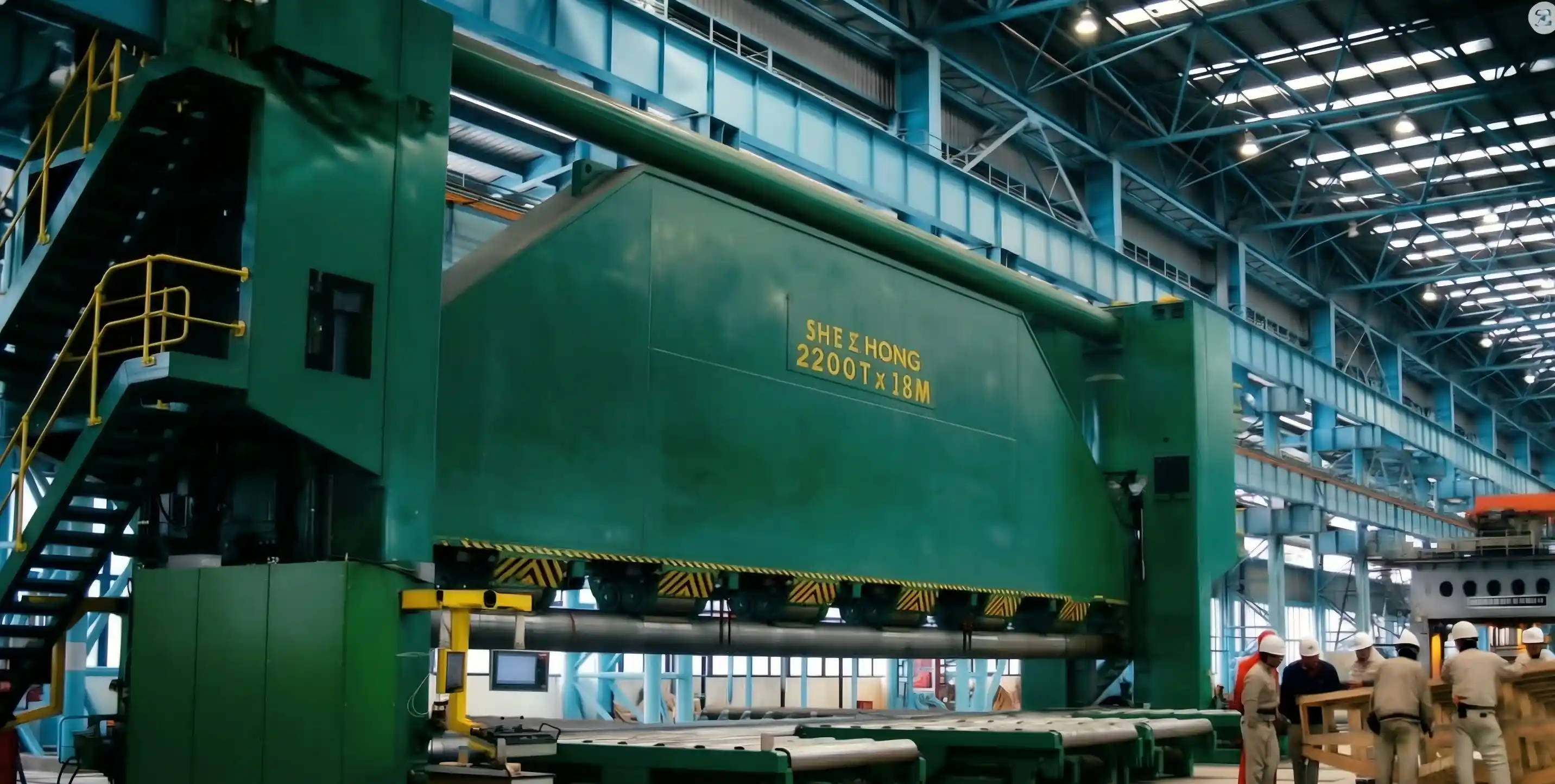
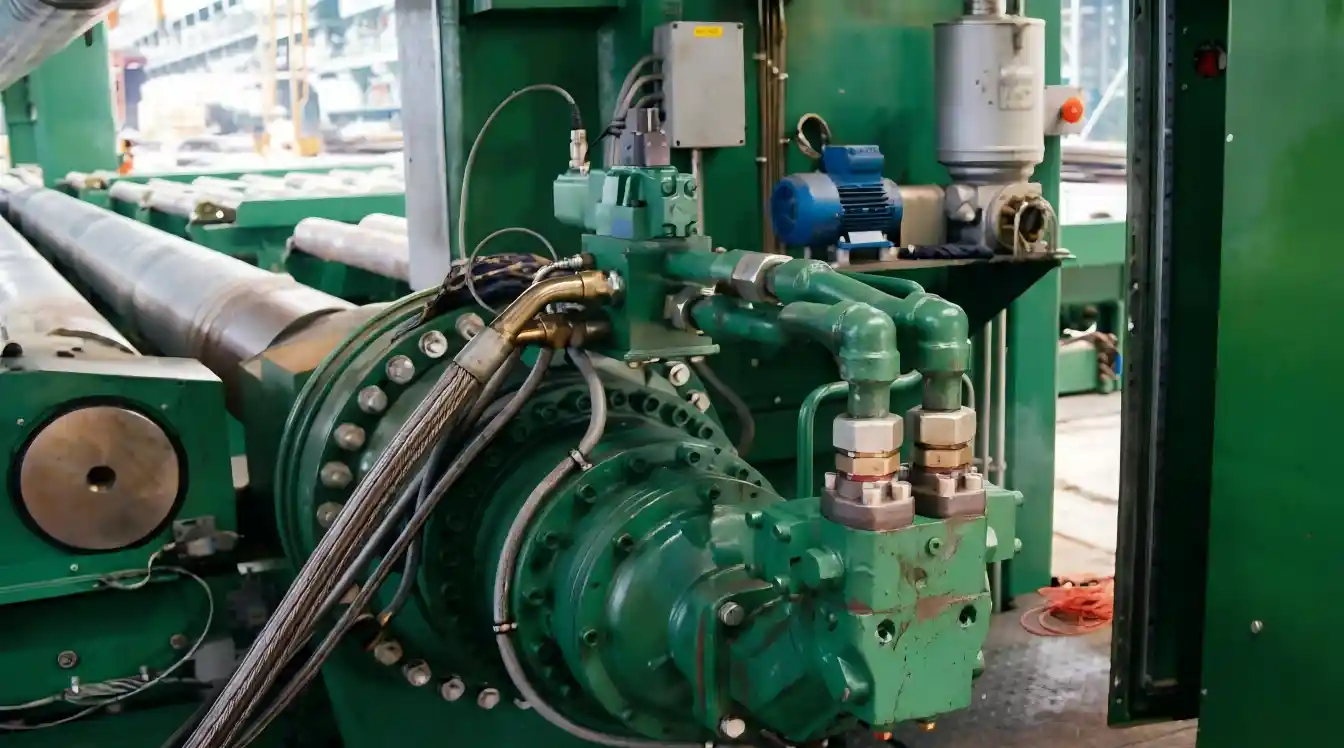
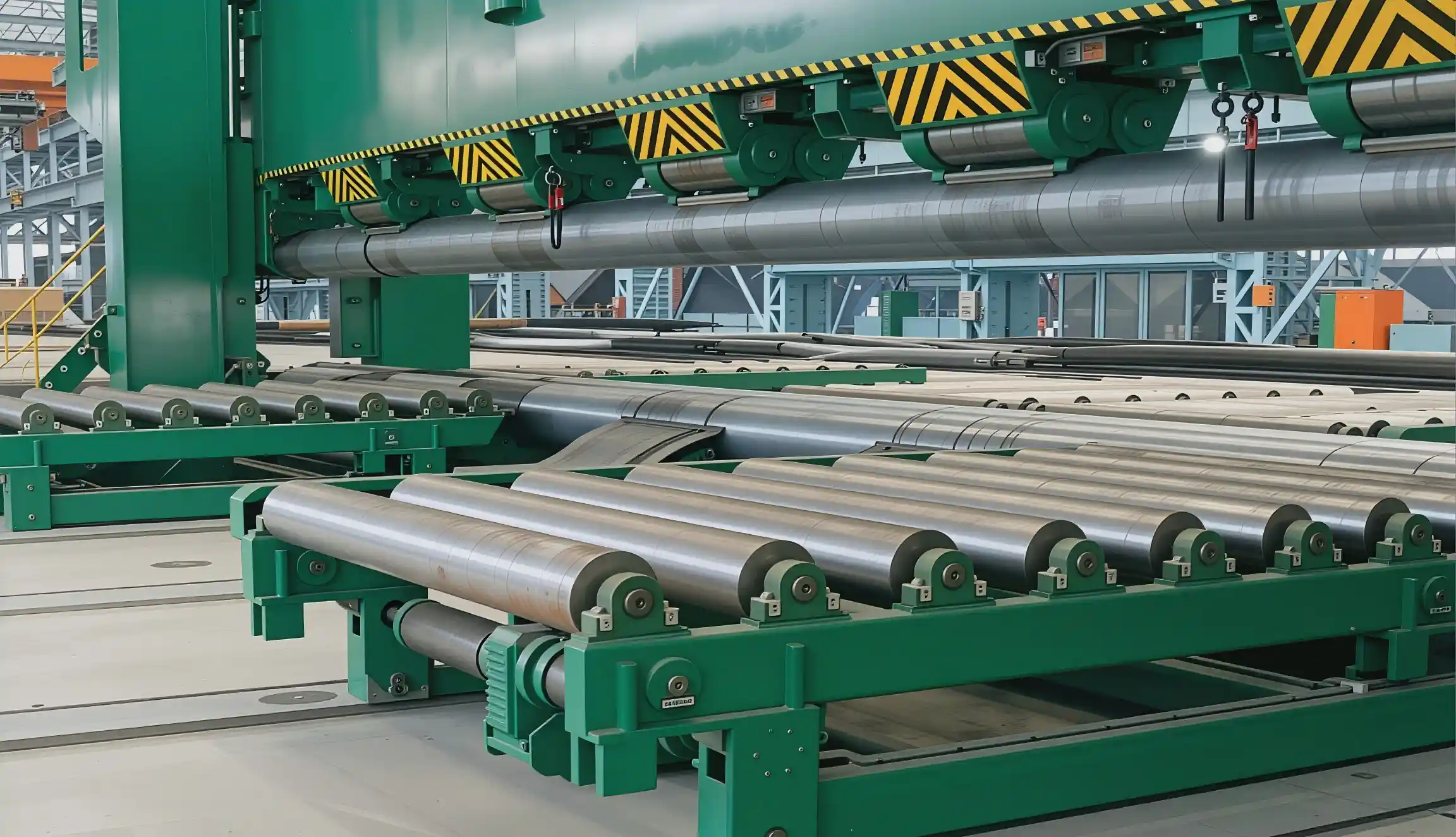
Each lower roller driven by separate electric motor or hydraulic motor with independent reducer. Eliminates mechanical cross-shaft interference, extending roller life and improving workpiece surface quality by 60% vs. single-drive systems.
Adjustable lower roller spacing accommodates diverse bending radii and plate thicknesses. Enables production of both cylindrical sections and complex eccentric profiles on single machine—critical for ship hull construction.
Lower roller horizontal movement via mechanical transmission (worm-gear reducer + universal joint coupling) ensures synchronization without oil cylinder timing complexity. Self-locking mechanical design prevents unintended roller drift during high-pressure rolling.
Multi-point support roller assemblies with proportional valve control automatically compensate upper and lower beam deflection under load. Maintains linear straightness ±1.5mm across entire 2200mm width—critical for precise flange alignment on ship sections.
Specialized offset-axis rolling capability produces hatch frames and grooved cabin structures without secondary forming. Reduces manufacturing steps, improves lead time, enhances structural integrity.
Integrated die fixtures (with optional quick-change cartridges) enable 90° sharp corner bending and slotted hatch flange production—transforming single machine into multi-function ship fabrication cell.
Revolutionary design borrowed from British "Smith" technology (licensed). Each lower roller couples to dedicated motor (electric or hydraulic) via planetary reducer—eliminating mechanical gear interference that plagued traditional cross-shaft designs.
Precision Metrics: Drive Synchronization: ±3% torque difference | Motor Response Time: <100ms | Steady-State Accuracy: ±1% speed variation under full load
Lower roller spacing adjusts from minimum (tight plate dragging) to maximum (broad radius bending). Hydraulic or mechanical adjustment enables rapid changeover between different hull section geometries.
Operational Impact: Changeover Time: 15-20 minutes | Setup Precision: ±5mm detents | Load Capacity: Maintained at full tonnage across entire range
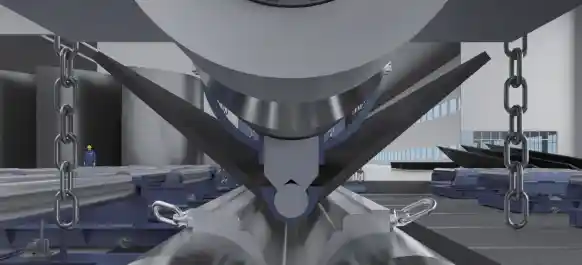
Upper and lower beams supported by arrays of cylindrical rollers (backup rollers) that actively compensate for elastic deflection under load. Each support roller controlled by individual proportional hydraulic cylinder.
Quality Impact: Straightness Tolerance: ±1.5mm over 2200mm | Flange Alignment: Reduces rework 40% | Internal Stress Distribution: Even load prevents stress concentration
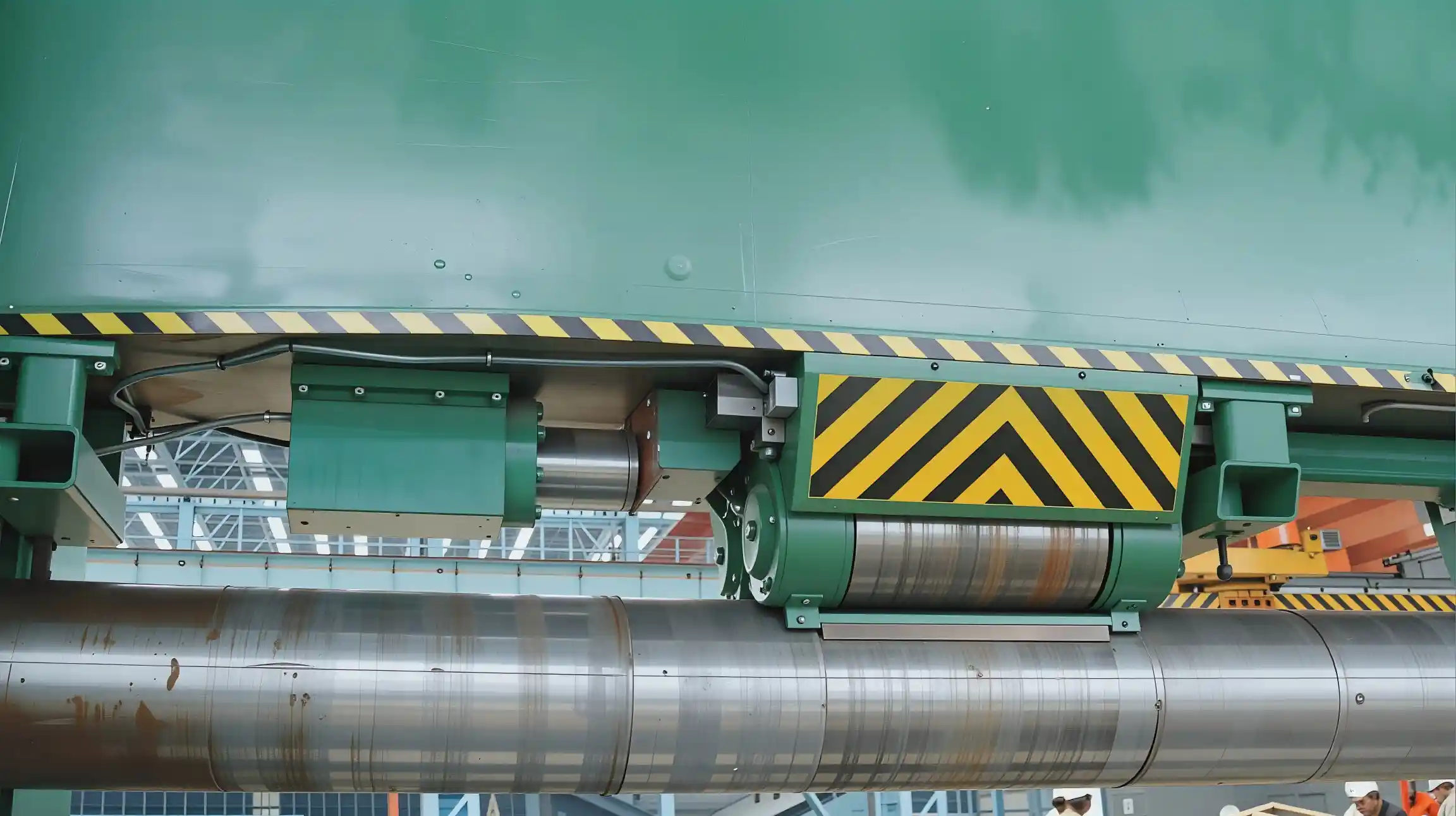
Specialized offset-axis rolling configuration enables production of angled hatch frames, sloped cabin walls, and transition sections without secondary forming operations.
Quick-change die cartridge system enables transformation from rolling machine to corner-bending press. Upper roller couples to angular die insert; lower roller acts as support table.
Quick-Change Process: Cartridge Mounting: V-block precision locating, 4 quick-release bolts | Change Time: <15 minutes | Precision: Repeatability ±0.5mm
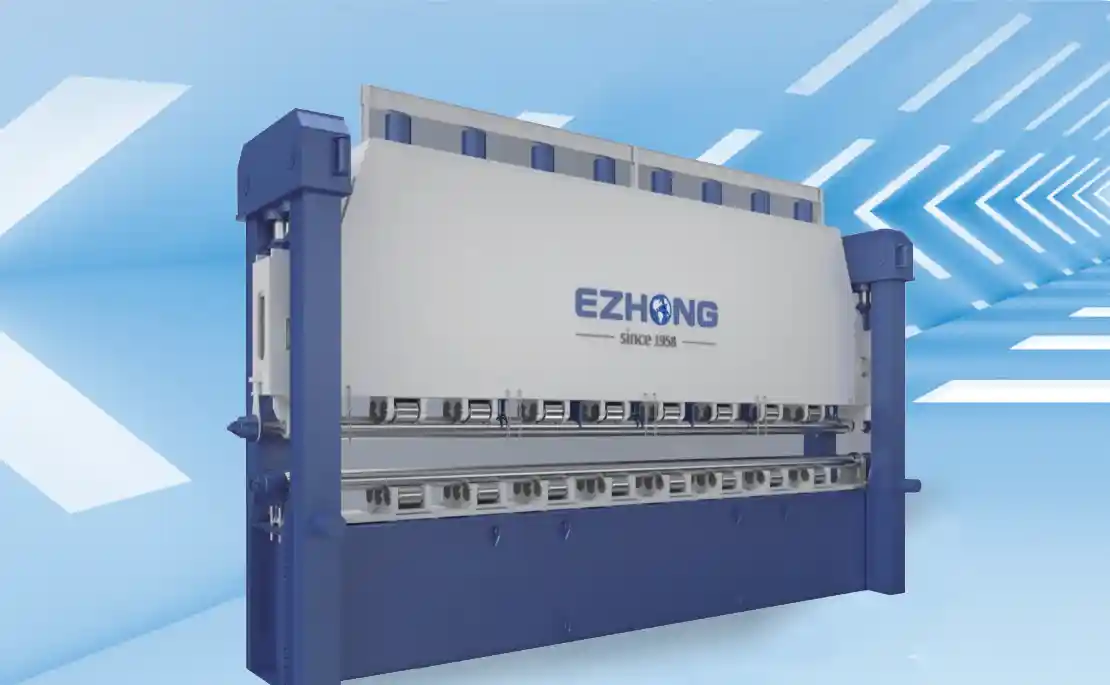
High-strength structural steel (Q355, DIN StE355), fully stress-relieved. Per DNV-GL certification. Frame deflection <0.8mm under full rated load across 2200mm width. Precision finishing flatness ±0.5mm/meter.
Left and right lower rollers 42CrMo forged steel diameter 250-300mm. Dedicated electric motor 15-30 kW + planetary reducer ratio 1:60. Worm-gear reducer ratio 1:100 with universal joint coupling.
Swashplate variable displacement pump 100-150 cc/rev. 3000-4000L oil tank with internal baffles. 40 kW plate-frame oil cooler. 10μm absolute filtration. DNV-certified relief valve with flame-resistant hoses.
Upper and lower beam supports 4-7 cylindrical rollers 125mm diameter. Individual proportional hydraulic cylinders bore 40-50mm. Load capacity 300-500 kN per support point. Positioning precision ±2mm via LVDT.
| Model | Plate Width (mm) | Min Radius (mm) | Support Rows | Motor Power (kW) | Capacity (T) | Dimensions L×W×H (mm) |
|---|---|---|---|---|---|---|
| 3R-1000×12500 | 1000 | 600 | — | 30×2 | 150 | 12500×1200×2400 |
| 3R-1500×13500 | 1500 | 600 | — | 55×2 | 200 | 13500×1700×2600 |
| 3R-2000×17000 | 2000 | 650 | — | 75×2 | 250 | 17000×2200×2800 |
| 3R-2200×18000 | 2200 | 650 | 4(6) | 75×2 | 280 | 18000×2400×3000 |
| 3R-2200×21000 | 2200 | 650 | 4(7) | 75×2 | 300 | 21000×2400×3200 |
Answer a few quick questions to help us recommend the most suitable plate bending machine for your application.
AH32, AH36, EH36 marine-grade steel | Thickness 15-40mm | Typical Radius 800-2500mm | Perfect surface finish; no scratches; precise roundness for welding alignment.
A-Grade, AH32 marine steel | Thickness 12-25mm | Typical Angle 30-45° eccentric profile | Precise angle consistency ±0.5°; smooth flange transitions for welding.
AH32, DH36 | Thickness 10-30mm | Typical Diameter 1200-3000mm | Ovality ≤1.5%; internal/external surface cleanliness.
A-Grade, AH32 | Thickness 8-20mm | Typical Width 200-400mm | Groove profile consistency; smooth transitions prevent water pooling.
Specialty alloys duplex 2205, austenitic 316L | Thickness 6-25mm | Typical Offset ±100-150mm | Complex 3D geometry precision; smooth transitions eliminate stress concentrations.
AH36, EH36 high-strength steel | Thickness 20-40mm | Multiple rolled sections welded into box-beam | Dimensional accuracy for engine bolt-down; stress distribution uniformity.
Challenge: Traditional 4-roll
machines produced inconsistent hatch coaming angles
(±1.5-2° variation). Defective sections required
manual correction welding, consuming 3-4 hours per
100 sections. Production bottleneck: 40 vessels/year
vs. market demand 60+/year.
Solution:
Deployed 3R-2200×21000 dual independent lower-roller
machine with eccentric rolling capability.
Result:
Defect Rate reduced from 8% → 0.5%. Rework Time
eliminated 3-4 hours/100 sections. Production
Capacity increased from 40 → 62 vessels/year. Annual
Revenue Impact +€45M. Payback Period 11 months.
Challenge: Luxury cruise ships
demand flawless visible hull sections. Previous
machine's ±3mm deflection tolerance caused alignment
problems in welding; rework cost €800-1200/section
across 80-100 sections/ship.
Solution:
Integrated 3R-2200×18000 with advanced deflection
compensation (7-point backup roller support) +
in-line laser measurement feedback.
Result:
Surface Quality eliminated visual defects;
straightness tolerance ±1.5mm achieved. Rework Cost
reduced from €80K-120K → €5K per ship (94% savings).
Lead Time reduced hull fabrication by 2 weeks. Zero
warranty claims for hull section defects.
Challenge: Container ship demand
surge required 40% production increase. Existing
equipment baseline insufficient. Needed rapid
capacity expansion without massive floor space
addition.
Solution: Added
second 3R-2200×21000 machine configured for
mixed-geometry production (cylindrical + eccentric
sections).
Result:
Capacity Expansion +40% vessel production without
additional floor space. Asset Utilization 87% → 94%.
Operator Efficiency cross-trained 6 operators; labor
productivity +35%. Investment Payback 14 months.
Challenge: Offshore support vessels
require specialty high-strength steel (EH36, 6YK)
with aggressive curves. Previous machine suffered
12% material scrap rate due to surface defects
during eccentric rolling.
Solution:
Deployed 3R-2200×18000 with dedicated EH36-optimized
pressure curve + enhanced surface protection
(ceramic-coated upper roller).
Result:
Scrap Rate reduced from 12% → 0.8%. Material Yield
improved from 88% → 99.2%. Annual Savings €420K
material cost reduction. Quality Confidence enabled
supply to ultra-premium clients.
Full-load minimum radius is 600-650mm depending on model. Half-load (150T) can reach 500mm. Material thickness and grade significantly impact achievable radius—higher strength steels (EH36) require larger radii than lower grades.
Seven independent support roller hydraulic cylinders are controlled by PLC algorithm. Real-time pressure feedback from each support point calculates optimal load distribution to counteract beam deflection. Laser measurement provides feedback loop; deviations >0.5mm trigger automatic support point adjustment.
Yes. Machine accommodates mill scale surface (typical for marine-grade plate shipments). Integrated scrapers remove scale particles before rolling. Recommendation: blast cleaning to Sa 2.5 prior to rolling for optimal surface finish.
Offset range ±150mm from centerline enables angle production from 0-45°. Precision ±0.5° angle tolerance maintained via servo hydraulic tilt control. Load capacity at 30° offset is ~80% rated tonnage; at 45° offset, ~60% rated tonnage.
Approximately 12-15 minutes per cartridge swap (including pressure system purging). No special tools required; operator-level maintenance. Cartridges are physically interchangeable across fleet; repeatability ±0.5mm.
500 operating hours (typically 3-4 weeks at continuous 2-shift operation). Service includes hydraulic oil & filter change, bearing re-lubrication, proportional valve spool cleaning, pressure valve calibration, seal inspection. Full maintenance cycle: 12-16 hours.
Yes. Standard Ethernet/RS-485 connectivity. Data export includes: job ID, section type, material grade, thickness, bending radius, production time, operator ID, quality measurements, pass/fail status. Integration typically requires 2-3 weeks engineering + IT coordination.
Yes. Cold rolling is standard (50°C ambient max). Hot rolling variant available (up to 1000°C for specialty alloys like duplex, austenitic stainless). Same machine can switch between modes with reconfiguration; recommend 2-3 hour settling time between hot/cold transitions to prevent thermal distortion.
DNV-GL certification (Det Norske Veritas - Lloyd's Register equivalent for maritime). Covers pressure relief valve settings, hose specifications, hydraulic fluid marine-grade requirements, electrical safety for shipyard environment. ABS approval available as option.
Factory calibration during commissioning maps beam deflection curve across full load range. On-site re-calibration recommended annually via laser measurement dial-in procedure (2-3 hours). Provides lookup table for operator dashboard; auto-adjusts support pressure per material/thickness.
All proportional valves spring-center to neutral (safe idle position). Accumulated pressure in surge tank maintains controlled unload via pressure relief valve. Workpiece remains safely on machine; no free-fall risk. Operator can manually unload via hand pump if emergency power unavailable.
Yes. These materials require different pressure curves and slower speeds (1.0-2.0 m/min vs. standard 2.5-4.0 m/min). PLC control accommodates material-specific profiles stored in database. Recommend consultation with EZHONG engineering for first-time specialty alloy production.
| Accessory | Lead Time | Function | Marine-Specific Value |
|---|---|---|---|
| Advanced Deflection Compensation (7-Point) | 6 weeks | Premium support roller matrix for ultra-flat sections | Essential for luxury ships; straightness ±1.5mm enables flawless visible hulls |
| In-Line Laser Measurement System | 10 weeks | Real-time diameter, ovality, straightness feedback | Detects defects mid-rolling; enables automatic pressure correction; 99.5% first-pass quality |
| Quick-Change Die Cartridge Library | 8 weeks | 6-8 different die profiles for multi-function capability | Transforms machine from rolling to corner-bending to slotted-groove production |
| Eccentric Rolling Precision Package | 6 weeks | Enhanced servo control for offset/angle production | ±0.3° angle precision for hatch coaming; eliminates manual correction |
| Marine-Grade Hydraulic Oil System | 4 weeks | Corrosion-resistant fluid + enhanced cooling + salt-spray sealing | Critical for tropical/offshore operations; extends hydraulic component life 40% |
| Integrated Tack-Welding Station Interface | 9 weeks | Coordinated positioning with downstream welding robot | Ensures section transfer precision ±2mm; speeds hand-off; prevents damage |
| Horizontal Plate Transfer Conveyor | 10 weeks | Motorized conveyor links roller output to welding preparation station | Eliminates manual section movement; speeds workflow; prevents denting |
| Remote Diagnostics & Predictive Maintenance | 6 weeks (subscription: €12K/year) | Cloud-based monitoring, ML-based failure alerts | Prevents 85% unplanned downtime; maritime operators highly value reliability |
| Hot-Rolling Configuration Package | 12 weeks | Enhanced rollers, improved cooling, insulation | Enables processing of specialty alloys (duplex, austenitic) up to 1000°C |
| DNV-GL Certification Upgrade | 8 weeks | Third-party maritime regulatory approval | Required for certain shipyard insurance/classification; adds resale value |