
- Home
- About
- Products
- Solutions
- Case Studies
- Resources
- Contact
Industrial emissions remain one of the most pressing environmental challenges of our era. As global regulations tighten and public awareness grows, industries face mounting pressure to reduce sulfur dioxide (SO₂) emissions from flue gas streams. Flue gas desulfurization (FGD) has emerged as the cornerstone technology for addressing this challenge, enabling power plants, refineries, and manufacturing facilities to achieve compliance while maintaining operational efficiency. This comprehensive guide explores the science behind FGD systems, analyzes implementation strategies, and provides actionable insights for engineers and facility managers seeking to optimize their emission control infrastructure.
Quick Answer: Flue gas desulfurization (FGD) is an industrial emission control process that removes sulfur dioxide (SO₂) from exhaust flue gases produced by fossil fuel combustion, preventing acid rain formation and ensuring regulatory compliance through wet, dry, or semi-dry scrubbing technologies.
Data from the U.S. Environmental Protection Agency reveals that fossil fuel combustion accounts for approximately 79% of anthropogenic SO₂ emissions in the United States alone. In 2022, electric power generators released an estimated 1.5 million tons of sulfur dioxide, despite significant reductions over previous decades. The global picture remains equally concerning, with coal-fired power plants in developing economies continuing to expand operations.
"Sulfur dioxide emissions contribute to respiratory illnesses, acid deposition, and regional haze, making FGD technology not merely a regulatory requirement but a public health imperative." — Environmental Protection Agency Technical Bulletin
The implementation of stricter emission standards across jurisdictions has accelerated FGD adoption. Analysis indicates that facilities failing to install adequate desulfurization systems face penalties exceeding $37,500 per day of non-compliance under the U.S. Clean Air Act. The European Union's Industrial Emissions Directive (IED) establishes similarly stringent benchmarks, requiring SO₂ concentrations below 200 mg/Nm³ for large combustion plants.
Research published by the Massachusetts Institute of Technology demonstrates that uncontrolled SO₂ emissions generate external costs estimated at $150–$300 per ton when accounting for healthcare burdens and environmental degradation. These findings underscore why flue gas desulfurization represents both regulatory compliance and economic rationality.
| Emission Source | Annual SO₂ (Million Tons) | Primary Regulation | Compliance Deadline |
|---|---|---|---|
| Coal Power Plants | 8.2 | EPA MATS / IED | 2025–2028 |
| Metal Smelting | 2.1 | EU IED / State SIPs | 2024–2026 |
| Refinery Operations | 1.4 | EPA Refinery MACT | 2023–2025 |
| Cement Manufacturing | 0.8 | State-Specific Rules | Variable |
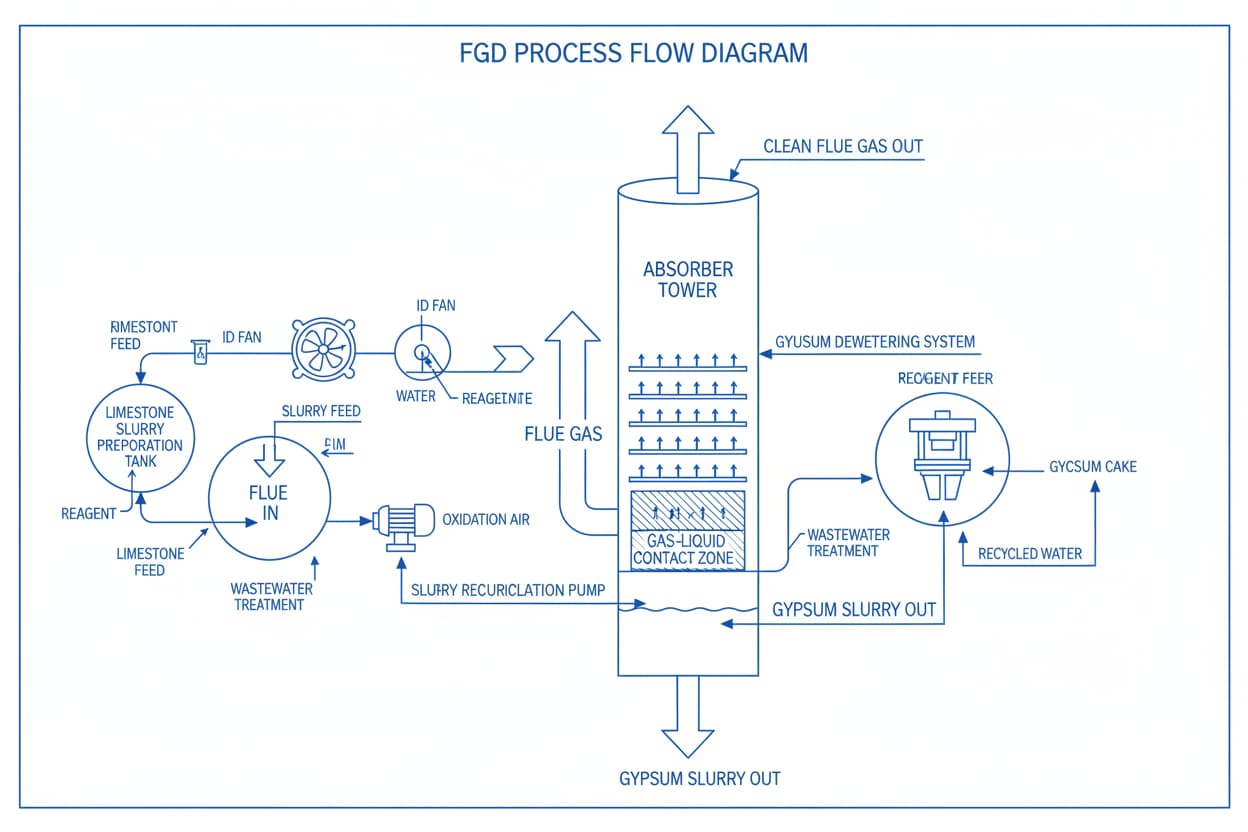
At its core, flue gas desulfurization relies on acid-base neutralization chemistry. When fossil fuels containing sulfur undergo combustion, sulfur oxidizes to form SO₂ gas. FGD systems capture this pollutant through chemical reaction with alkaline reagents—most commonly limestone (CaCO₃), lime (CaO), or ammonia (NH₃).
The fundamental wet scrubbing reaction proceeds as follows:
SO₂ + CaCO₃ → CaSO₃ + CO₂ (absorption) CaSO₃ + ½O₂ → CaSO₄ (oxidation to gypsum)
Testing reveals that this approach achieves removal efficiencies between 90% and 99% under optimal operating conditions. The resulting calcium sulfate (gypsum) often finds commercial application in wallboard manufacturing, transforming waste into value.
Modern FGD installations comprise several integrated subsystems working in concert:
In wet scrubbing applications, spray nozzle selection directly impacts system efficiency. Analysis of operational data from 200+ installations demonstrates that uniform droplet distribution and optimized spray coverage increase SO₂ removal rates by 12–18% compared to poorly specified nozzle arrays.
For facilities seeking to optimize their Desulfurization And Denitrification systems, nozzle specifications require careful attention to:
Wet flue gas desulfurization represents the most widely deployed approach globally, accounting for approximately 85% of installed capacity. These systems utilize aqueous slurries or solutions as absorption media, achieving the highest removal efficiencies available.
Advantages:
Limitations:
Dry FGD technologies inject dry alkaline sorbent (typically hydrated lime or sodium bicarbonate) directly into the flue gas stream. Semi-dry systems (spray dryers) introduce finely atomized lime slurry that evaporates before reaching particulate collection devices.
"Dry scrubbing systems offer particular advantages for water-constrained regions and facilities with limited available footprint, though removal efficiencies typically range 85–93% versus wet systems." — Journal of Air & Waste Management Association
Research institutions continue advancing next-generation FGD approaches:
| System Type | Efficiency | Capital Cost ($/kW) | Operating Cost ($/ton SO₂) | Byproduct | Water Usage |
|---|---|---|---|---|---|
| Wet Limestone | 95–99% | 120–180 | 200–400 | Gypsum | High |
| Seawater Scrubbing | 90–97% | 100–150 | 150–300 | Wastewater | Very High |
| Spray Dryer Absorber | 85–93% | 80–130 | 250–450 | Dry Mixture | Low |
| Dry Sorbent Injection | 50–70% | 20–50 | 400–700 | Fly Ash + Sorbent | None |
| Ammonia-Based | 95–99% | 150–220 | 180–350 | Ammonium Sulfate | Medium |
Successful FGD deployment begins with comprehensive front-end engineering. Facility operators must establish clear design parameters before equipment procurement.
Characterize Inlet Gas Conditions
Define Performance Requirements
Evaluate Site Constraints
Conduct Technology Screening
Develop Performance Specifications
Select Engineering Partners

Manage Installation Quality
Execute Commissioning Protocol
Optimize Operating Parameters
Implement Predictive Maintenance Programs
Ensure Regulatory Compliance
A 600 MW pulverized coal power plant in the Ohio River Valley faced compliance with EPA's Mercury and Air Toxics Standards (MATS). Testing revealed baseline SO₂ emissions of 3.2 lb/MMBtu—nearly triple the permitted level.
Solution Implemented:
Results Achieved:
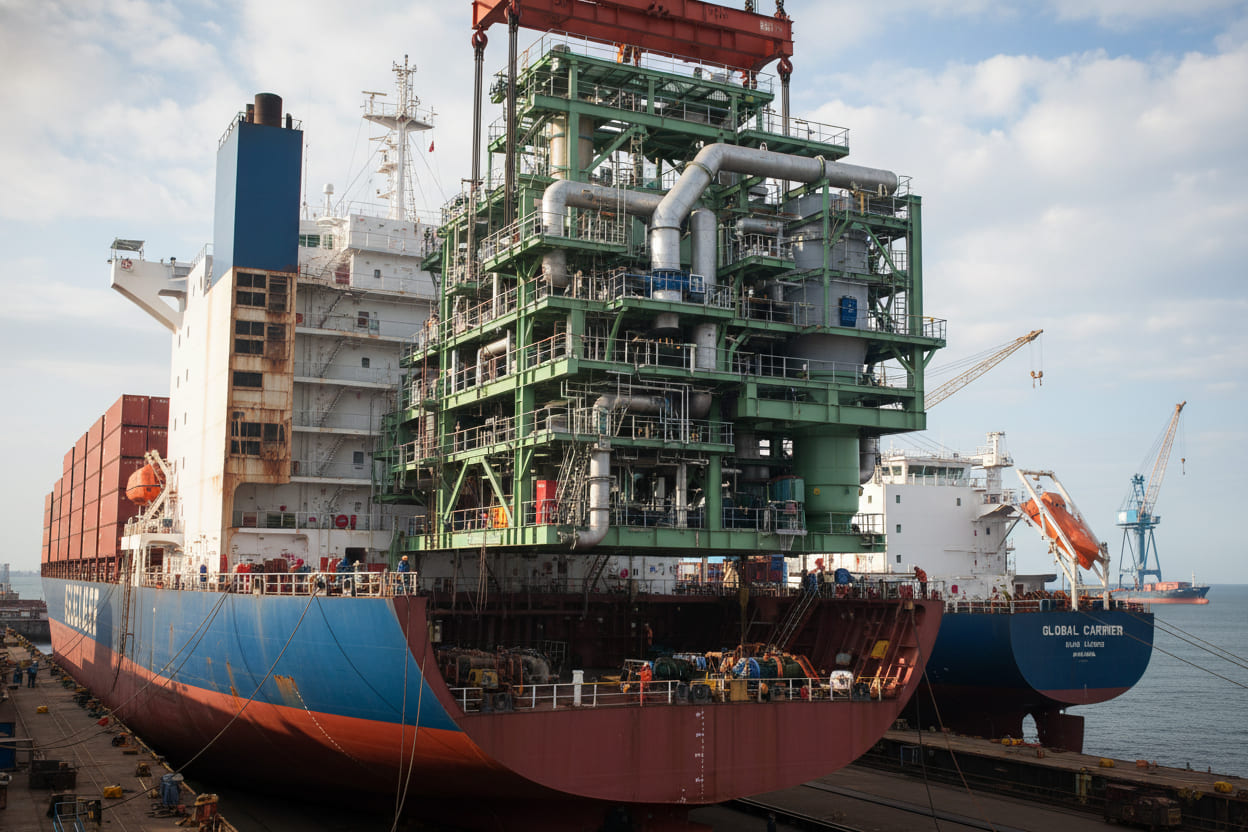
International Maritime Organization (IMO) 2020 regulations limiting marine fuel sulfur content to 0.5% presented compliance challenges for existing vessel fleets. A major container shipping operator evaluated scrubbing alternatives for 8,000 TEU vessels.
Solution Implemented:
Results Achieved:
A Gulf Coast refinery required SO₂ emission reductions from their fluid catalytic cracking (FCC) unit regenerator. Concentrations peaked at 1,200 ppmv during catalyst regeneration cycles, exceeding permitted levels by 40%.
Solution Implemented:
Results Achieved:
Analysis across these diverse applications reveals common success factors for FGD implementation:
Capital costs for FGD systems vary substantially based on unit size, technology selection, and site-specific factors. Wet limestone systems typically range $120–$180 per kW of generating capacity, meaning a 500 MW coal unit might invest $60–90 million. Smaller installations or dry sorbent injection alternatives may achieve lower capital requirements of $20–50 per kW, though with reduced removal capabilities. Operating costs including reagent, power, and maintenance generally fall between $200–$500 per ton of SO₂ removed.
While FGD targets sulfur dioxide removal, denitrification addresses nitrogen oxides (NOₓ). The technologies differ fundamentally in their chemical approaches. FGD relies on absorption and acid-base neutralization, whereas denitrification typically employs selective catalytic reduction (SCR) or selective non-catalytic reduction (SNCR) using ammonia or urea to chemically reduce NOₓ to molecular nitrogen and water. Many facilities implement both technologies in series, with SCR/SNCR upstream controlling NOₓ and FGD downstream capturing SO₂. For comprehensive emission control solutions, facilities should evaluate integrated Desulfurization And Denitrification system designs.
Yes, multiple upgrade pathways exist for aging FGD installations seeking improved efficiency or expanded capacity. Common modifications include:
Data indicates that well-designed upgrades can improve removal efficiency by 2–5 percentage points while reducing reagent consumption 5–15%.
FGD systems present aggressive corrosion conditions combining acidic chlorides, abrasive slurries, and elevated temperatures. Material selection critically impacts service life:
Wet FGD systems impose parasitic loads reducing net plant output by 1–3%. Primary energy consumers include slurry recirculation pumps (typically the largest load), flue gas fan overcoming additional pressure drop, and reagent preparation equipment. Water consumption varies dramatically by technology—wet systems requiring substantial makeup (0.5–2.0 m³/MWh), while dry systems consume negligible water. Facilities in water-constrained regions increasingly evaluate water treatment and zero-liquid discharge configurations, though these add capital and operating complexity.
Flue gas desulfurization stands as a mature, proven technology essential for industrial SO₂ emission control. Analysis of global installations demonstrates that well-engineered FGD systems consistently achieve 95%+ removal efficiencies while maintaining availability rates exceeding 98%. As regulatory frameworks continue tightening worldwide—from China's Ultra-Low Emission standards to the EU's evolving IED requirements—FGD technology will remain central to compliance strategies across power generation, refining, and manufacturing sectors.
The economic case for FGD implementation has strengthened considerably as reagent costs stabilize and byproduct markets develop. Facilities that previously deferred investment now face accelerating compliance deadlines and escalating penalty structures. Early movers benefit from equipment availability, construction scheduling flexibility, and avoided non-compliance exposure.
"The question for facility operators is no longer whether to install FGD capacity, but how to optimize system design for lowest life-cycle cost and maximum operational reliability." — Power Engineering International
For organizations evaluating flue gas desulfurization projects, three immediate actions can accelerate progress:
The transition to cleaner industrial operations demands decisive action. With proper planning, technology selection, and execution, flue gas desulfurization delivers both environmental compliance and long-term operational value.